Amenorrhea is the absence of periods (menstrual bleeding) for more than 6 months. Absence of periods during 2-6 months called oligomenorrhea. Amenorrhea could be primary or secondary. Primary amenorrhea is the absence of menstrual bleeding and secondary sexual...
 Mayer-Rokitansky-Küster-Hauser syndrome named after August Franz Joseph Karl Mayer, Carl Freiherr von Rokitansky, Hermann Küstner, and G. A. Hauser. Mayer-Rokitansky-Küster-Hauser (MRKH) syndrome is a rare and special condition discovered in females who have...
 What is Cushing’s disease? Cushing’s disease is relatively rare hormonal disorder in which the pituitary gland releases too much AdrenoCorticoTropic Hormone (ACTH). ACTH is normally produced by the pituitary gland (located in the center of the brain) to stimulate the...
 Testicular Feminization syndrome (so called “Androgen Insensitivity Syndrome”) is a genetic condition (disorder) when female body with male XY genetics is not able to response to existing male hormone (testosterone). During Testicular Feminization (TF), the male XY...
 Amenorrhea & Hyperprolactinemia is very complicated situation which could be noted in many women suffering from absence of menstrual cycles. AMENORRHEA Amenorrhea is the absence of periods (menstrual bleeding) for more than 6 months. Absence of periods during 2-6...
 Amenorrhea during obesity could be noted pretty often. Let’s try to understand why and how it is happening. Obesity Definition General definition of obesity is an excess proportion of total body fat. Woman is considered obese when her weight is 20% or more above...
 Polycystic Ovarian Syndrome (PCOS) is a complicated syndrome which is characterized with on-going multiple follicles development in ovaries which produce high concentration of androgens (male hormones), particularly testosterone. Severe hormonal disbalance in PCOS...
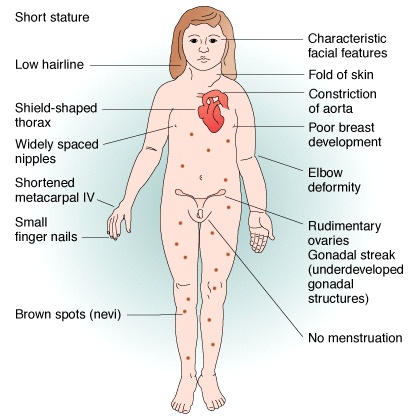 Turner Syndrome is named after doctor-endocrinologist Dr. Henry Turner who became famous in 1938 by describing the syndrome first time in medical history. Turner Syndrome affects only females and characterized by complex of symptoms including extra skin on the neck...
 The term premature ovarian failure describes a stop in the normal functioning of the ovaries in a woman younger than age 40. Some people also use the term primary ovarian insufficiency to describe this condition. It is also known as hypergonadotropic hypogonadism....
 Anorexia is an eating disorder where girls starve voluntary – it usually starts in puberty when girls have extreme weight loss. Anorexia symptoms start when weight loss is usually 10%-20% below the person’s normal body weight. People suffering from...
 Amenorrhea is the absence of periods (menstrual bleeding) for more than 6 months. Absence of periods during 2-6 months called oligomenorrhea. Amenorrhea could be primary or secondary. Primary amenorrhea is the absence of menstrual bleeding and secondary sexual...
 Usually brown vaginal discharge is most often associated with menstrual period and old endometrial tissues. It could be seen when blood has taken longer than usual to exit reproductive organs (uterus, cervix and vagina). Sometimes brown discharge is just vaginal...
 Ovulation is the important period of the menstrual cycle. Ovulation can be considered as one of indicators of women reproductive health. Ovulation is the indicator of normal cyclic hormonal production in women body. Normal regular menstrual cycles are not possible...
 It is well known that menstrual bleeding (period) occurs approximately every 28 days (± 4 days). Although some variations can be normal, menstrual bleeding at intervals of greater than 35-36 days may indicate oligomenorrhea — abnormally infrequent menstrual bleeding...
 According to Barbara L. Parry and Patricia Haynes, women have a significantly higher risk for developing mood disorders than men. Although reasons for this gender difference are not fully understood, it is clear that changing levels of reproductive hormones throughout...