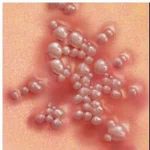
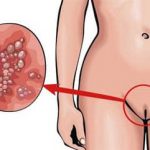
Herpes zoster (Shingles, zoster, zona) is a very specific infection disease triggered by reactivation of the varicella-zoster virus (VZV). This virus affects peripheral or cranial nerves and it develops painful blistering skin rash. Inflammation of the nerve axons results in a painful, burning sensation on the affected area. Herpes zoster usually appears in a band, a strip, or a line, or a small area on one side of the face, neck or body. Most common location of the skin eruption is thorax. Skin manifestation is usually unilateral and do not cross the mid-line of the body.
Herper zoster is commonly developed in older women with weakened immune system caused by stress, injury, specific medications, or other reasons.
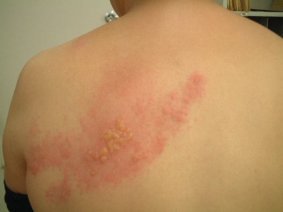
Herpes Zoster
Herpes Zoster causes
Main cause of Herper Zoster is reactivated virus which means the affected person already had chickenpox in early childhood, the virus remained inactive (dormant) in nerve roots (in the sensory nerve ganglion) for years and the disease occurs after the virus becomes active again years later.
Most experts don’t know the reason why the virus suddenly becomes active again but in most cases weakened immune system triggers the virus activation. It is important to mention that after the VZV becomes active again, it can only cause shingles but not chickenpox.
Sometimes shingles can be transmitted to another person (pretty rare).
Herpes Zoster risk factors
Presently the VZV reactivation process is not fully understood by experts. At the same time some risk factors were identified. Anybody who had chickenpox in childhood could get shingles but old women after 55-60 are considered as a risk group for Herpes Zoster – the older the person, the higher is the risk.
Women with weakened immune system also have increased chances for Herpes Zoster. Immune system can be suppressed because of serious diseases or certain medications (stress, cancer, HIV/AIDS, organ transplantation, etc.). Most often the Herpes Zoster is observed in white race women.
Direct contact with shingles rash persons could trigger chickenpox. Contacts with healthy pregnant women are forbidden (not recommended!).
Herpes Zoster symptoms
Hepres Zoster symptoms usually develop in stages. The preliminary symptoms could be confusing – headache, increased sensitivity to the light, fever, flu-like symptoms, dizziness, weakness, disturbed vision and not clear thinking. Sometimes clients could feel muscle weakness and “moving itching”.
Later symptoms are more clear – itching, tickling, tingling, and/or numbness, and/or pain in a certain area (always one side). Early symptoms of Herpes Zoster are one-sided pain (without any visible reasons), tingling and/or burning sensation. The pain and burning could be pretty severe and skin rash appears later (after few days). Slowly skin rash turns into clusters of blisters full of fluid. The skin rash camera caused by shingles is usually more painful than itchy.
Red patches on the skin and blisters (different sizes) could create huge discomfort. After few days skin blisters break, forming small ulcers that begin to dry and form crusts. Duration of this process could be different in different cases. In most cases crusts fall off after 2-3-4 weeks. Some women could mention unpleasant scars but in most cases scars disappear after few months.
During Herpes Zoster “attack” women usually experience strong skin rash which involves a narrow area from the spine around to the front of the belly area or chest. In most cases lymph nodes are involved in the process – doctors can discover swelling and tenderness.
Herpes Zoster symptoms usually occur on one side of the chest or back, but it may occur on the belly, head, face, eyes, mouth, ears, neck, or one arm or leg.
Some women could suffer also from abdominal pain, chills, genital lesions, hearing loss, joint pain, taste problems, loss of eye motion or vision problems.
Some symptoms of Herpes Zoster could lead to depression because of unbearable pain, disturbed sleep, difficulties in eating and performing normal daily activities.
Herpes Zoster diagnosis
In most cases diagnosis is not difficult because of obvious very specific symptoms. But sometimes tests are needed – skin sample to see if the skin is infected with VZV or blood tests for identifying increased white blood cells and antibodies to the chickenpox virus.
Herpes Zoster treatment
In most cases antiviral medicine is needed for Herpes Zoster treatment – these drugs help reduce the pain and complications as well as shorten the course of the disease (Acyclovir, Famciclovir, Valacyclovir). The medications should be started within 24 hours of feeling pain and/or burning sensations (preferably before the blisters appear). In cases of swelling some corticosteroids could be very useful.
Other symptomatic treatment could include antihistamines for skin itching, pain depressors and some creams for skin recovering. Some experts recommend cool wet compresses for pain reduction. Soothing baths and lotions, such as colloidal oatmeal bath, starch baths, or calamine lotion could also help to relieve skin itching and general discomfort.
If you have fever, it is better to spend few days in the bed until temperature goes down.
During skin blisters period the skin should be kept clean for secondary infection prevention – some topical antibiotics can be applied directly to the skin.
Herpes Zoster prevention
If you never had chickenpox, it is recommended to avoid touching the rash and blisters of persons with shingles or chickenpox. Nowadays Herpes Zoster vaccine is available – older women (after 60) can receive the Herpes Zoster vaccine as part of regular routine medical care.