Polycystic Ovarian Syndrome (PCOS) also known as Stein-Leventhal syndrome is a complicated endocrine disorder associated with a long-term lack of ovulation (anovulation) and an excess of androgens (male hormones, e.g., testosterone). PCOS affects an estimated 6-10% of...
 Symptoms of the Polycystic Ovarian Syndrome (PCOS) tend to start gradually. Often, hormone changes that lead to PCOS start in the early teens, after the first menstrual period. Symptoms could be more noticeable after weight gain in puberty. Usually women with PCOS...
 Causes of PCOS are not clearly known and there are several opinions concerning PCOS causes. Here we try to demonstrate different approaches to PCOS causes. PCOS causes according to “FertilityFactor.com” Polycystic ovarian syndrome (PCOS) tends to be caused by a chain...
 If you have PCOS and already get pregnant (with or without treatment) – congratulations because some women with PCOS cannot get pregnant even after treatment. Now that the stress of achieving conception is behind you, you may already be concerned about the next stage,...
 PCOS and Cancer: What’s the Risk? Polycystic Ovarian Syndrome (PCOS) is a condition which causes women to experience a number of symptoms, such as weight gain, acne, facial hair, irregular menstrual cycles, and infertility. Like many other conditions, those with...
 PCOS Diet & Lifestyle Plan By Louise O’Connor, Naturopath & Wellness Coach Health experts now agree that Polycystic Ovarian Syndrome (PCOS) is linked to insulin resistance syndrome, a condition that leads to poor blood sugar control and weight gain....
 According to Wikipedia, hirsutism (from Latin hirsutus = shaggy, hairy) is defined as excessive and increased hair growth in women in locations where the occurrence of terminal hair normally is minimal or absent. It refers to a male pattern of body hair (androgenic...
 Hirsutism treatment medical In general all anti-hirsutism tablets may help to slow hair growth down so that hairs become thinner and less noticeable. For significant effect the anti-hirsutism tablets should be taken up to 12 months and usually need to be continued for...
 The Ferriman-Gallwey score – scoring system (Ferriman DM, Gallwey JD.,1961) is used to score the degree of excess male pattern body hair (hirsutism) in women. The scorecard of every body location under survey begins from 0 (no excessive terminal hair growth) to...
 Hirsutism is a condition with excess hair growth in women in male pattern – on face, chest, areola, lower abdomen, upper back, lower back, buttocks, inner thighs and external genitalia. In most cases the main cause of hirsutism is hyperandrogenemia (high concentration...
 Some young girls and women suffer from unwanted hair growing on face and body. This skin condition called “HIRSUTISM” which means the presence of terminal hairs in females in a male-like pattern. Hirsutism in general affects 5% – 10% of women. Some causes of...
 Hirsutism is a term defined as excessive and unwanted hair growth in women in a male-type pattern (hair on the face, beard area, chest, and abdomen). Hirsutism causes could be different. Studies suggest that Constitutional Hirsutism affects 5% – 15% of women,...
 Young girls starting from puberty and women get concerned if they have unwanted hair – excessive dark or dense hair growth (called “hirsutism”) on their face or any other part of the body including facial hair and pubic and bikini hair. In women hirsutism may be...
 Hirsutism treatment – Tea ‘controls female hair growth’ (BBC news from 20.07.2007) Spearmint tea may help to control excessive hair growth in women, say Turkish researchers. Drinking the tea twice a day, reduced levels of male sex hormones, which can...
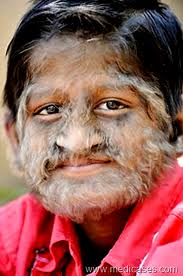 Hypertrichosis is a very specific medical terminology referring to unwanted condition of excessive body hair. Hyper-trichosis can be generalized, symmetrical (affecting symmetric parts of the body) or localized (affecting specific parts of body – never symmetric). The...